 |
The Man in the Storm: The Lesson of the Prophet JonahWhy does the prophet Jonah not listen to the word of the Lord and sail in the opposite direction? How and why do we run away from the Lord and the trials that befall us today? What is the source of a person's inner hopelessness, and how does avoiding our mission endanger the lives of those around us? Finally, how to surrender to our own crisis so that it creates change within us? How to hear the voice of God? Bishop Ruben Zargaryan is |
 |
Various healings (4:31-45)In verses 31-45 of the fourth chapter of the Gospel of Luke, Jesus performs various healings, casting out evil demons and unclean spirits from people. The demons recognized Him as the Son of God, but Jesus silenced them, silenced them so that His identity would not be revealed. Why did Christ silence the demons, what is the kingdom of God, why do we want to be close to the Lord or run away from ourselves, and do we continue to serve the Lord after receiving help? The Gospel passage is read by Father Markos Mangasaryan. |
 |
The Temptation of Jesus in the Desert (4:1-13)
The fourth chapter of the Gospel of Luke, verses 1-13, presents how the devil tempted Jesus in the desert for 40 days, tempting Him and offering Him three different temptations.
How does Christ remind us that we should not tempt God, and how can we ourselves, with the power of God, withstand the constant trials of our lives?
The Gospel passage is interpreted by Father Markos Mangasaryan.
|
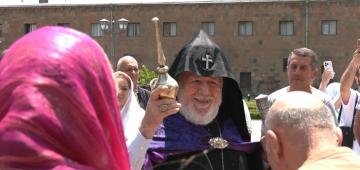 |
Feast of the Transfiguration in the Mother See of Holy Etchmiadzin
On July 12, on the occasion of the Feast of the Transfiguration of Christ, a festive liturgy was celebrated in the Mother Cathedral of Etchmiadzin under the presiding authority of His Holiness Karekin II, Catholicos of All Armenians.
During his speech, the liturgist Karekin Vardapet Hambardzumyan referred to the commemoration of Christ appearing to the disciples in divine glory on Mount Tabor, noting that every day can provide an opportunity for transformation.
At the end of the ceremony, the Armenian Patriarch blessed the people on the occasion of the Feast of the Transfiguration.
|
 |
Worship: The Highest Work
The more we depend on the Lord, the freer we are, and the further we are alienated from God, the closer we are to slavery. What parallels does ritual worship have with work? Bishop Ruben Zargaryan explains.
|
 |
The Preaching and Imprisonment of John the Baptist (3:10-20)
In verses 10-20 of the third chapter of the Gospel of Luke, the preaching of John the Baptist continues. What instructions did he give to the tax collectors and soldiers? What did he mean when he said, “I baptize you with water, but one mightier than I will come, the latchet of whose sandals I am not worthy to untie, and he will baptize you all with the Holy Spirit and fire?” Father Markos Mangasaryan comments.
|
 |
The Preaching of John the Baptist (3:1-9)
The third chapter of the Gospel of Luke, verses 1-9, presents the preaching of John the Baptist and how he prepares for the coming of the Lord. Father Markos Mangasaryan comments.
|
 |
Work: Service or Slavery?Why is work given to man in the Bible as a calling and mission, and also as a blessing? Bishop Ruben Zargaryan explains. |
 |
The Baptism and Genealogy of Jesus (3:21-38)The Gospel of Luke, chapter 3, verses 21-38, presents the baptism of Jesus Christ by John the Baptist. Jesus was baptized, although he had committed no sin, he was baptized so as not to be different, not to be set apart from others, he was baptized to show his humility. The Gospel passage is interpreted by Father Markos Mangasaryan. |
 |
Babylon: Public SinWhen is the Tower of Babel built, who was Nimrod, why was there only one language in that period, how does God respond to that building? Bishop Ruben Zargaryan explains. |
 |
Simeon the Elder and Anna the Prophetess (2:25-40)
In the second chapter of the Gospel of Luke, verses 25-40, Simeon the elder, who was commanded by the Holy Spirit not to see death before he had seen the Lord's Anointed, finally meets the baby Jesus in the temple, takes him in his arms, and blesses God. Father Markos Mangasaryan, the priest, comments.
|
 |
The Hymn of Zechariah (1:67-80)
The Hymn of Zechariah is presented in verses 67-80 of the first chapter of the Gospel of Luke. Father Markos Mangasaryan interprets.
|